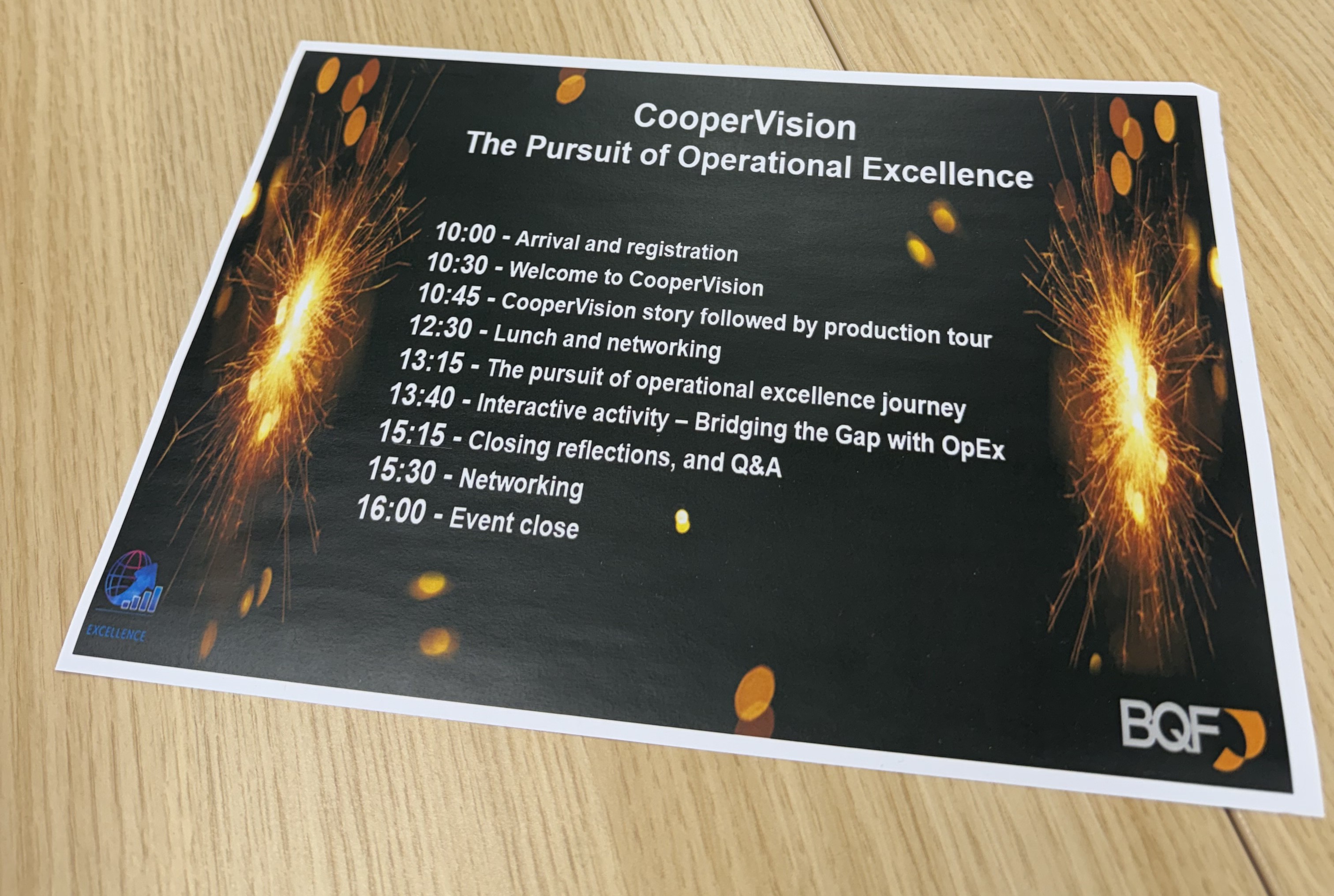
Two weeks ago, CooperVision hosted an insightful and engaging day for BQF members, combining a visit to its contact lens manufacturing facility with an exploration of the Operational Excellence (OpEx) principles and practices that underpin its manufacturing operations.
Following a warm welcome and introduction, members toured the manufacturing facility, seeing the machinery and production lines first-hand. bringing an impressive sense of scale to the visit.
The presentation shared an honest account of where the journey began, the challenges encountered along the way and the progress made in creating a more consistent, engaged and improvement-focused working environment.
What became clear throughout the day was that Operational Excellence is about much more than introducing new processes, tools or procedures. At its heart, it is about creating the right culture, empowering people and making continuous improvement part of everyday working life.
Why change was needed
Over time, different parts of CooperVision UK Manufacturing had developed their own ways of working. While these approaches had evolved to meet individual site requirements, they also created inconsistencies in processes, communication and performance management.
Recognising the opportunity to improve, the business began developing a more joined-up approach, with the aim of establishing common standards, improving visibility and encouraging greater collaboration between teams.
The challenge was not simply to introduce a new way of working, but to bring people along on the journey and help them understand the benefits of change.
Creating a better working environment
A key part of the programme has been the introduction of 5S, and visual management The principle is straightforward: ensuring people have what they need, where they need it, when they need it.
Members were shown examples of how working environments have been improved, from production areas and storage facilities to offices and maintenance spaces.
However, the real value of this approach goes beyond tidiness. It encourages people to take pride in their workplace, identify unnecessary waste and look for opportunities to make their everyday tasks easier and more effective.
Importantly, responsibility for maintaining these standards sits with the teams themselves, rather than being something imposed from above.
Bringing leadership closer to production teams
One of the most interesting aspects of the presentation was the change in the relationship between leadership and production teams.
Through regular Gemba walks, leaders spend more time in the workplace, talking to employees, listening to their concerns and understanding the challenges they face.
This has helped break down barriers and create a more open and approachable environment.
The presentation highlighted how something as simple as stopping to say hello, taking an interest and listening to people can make a real difference.
Seeing management in production areas is a normal part of working life.
The wider message was that good leadership is not just about making decisions from an office. It is about understanding what happens on the ground and working alongside people to resolve problems.
Giving people ownership and a voice
Another important development has been the introduction of regular team meetings, where employees take greater responsibility for discussing performance, raising issues and identifying solutions.
Rather than decisions always being passed up through management, more responsibility is being placed with the people closest to the work.
This has encouraged greater involvement, quicker problem-solving and a stronger sense of ownership.
CooperVision also shared its approach to encouraging employees to put forward improvement ideas, supported by a structured programme that helps turn those ideas into practical changes.
The message was clear: the people doing the job are often best placed to identify what could be improved upon.
Creating an environment where employees feel confident to speak up, contribute and see their ideas acted upon is an important part of building a sustainable improvement culture.
The importance of bringing people with you
The presentation was refreshingly open about the challenges of introducing change.
One of the lessons learned was that the strength of attachment to established ways of working had initially been underestimated. Changing processes is one thing, but changing habits and attitudes can be much harder.
The response has been to place greater emphasis on communication, understanding and support, rather than simply expecting people to adopt new procedures.
There was also an important recognition that standardisation does not mean treating everyone in exactly the same way. Different teams and individuals may have different needs, and successful improvement must recognise this.
Above all, the message was one of respect for people.
Operational Excellence should make working life easier, not more complicated. Standards need to be understood, supported and practical if they are to become part of everyday behaviour.
Celebrating progress and looking ahead
The results shared during the day demonstrated the positive impact the programme is having across the business.
CooperVision reported improvements in production performance, alongside stronger employee engagement, greater ownership of working environments and a renewed sense of pride among teams.
Perhaps most importantly, employees are increasingly involved in shaping how the business operates and improving the processes they work with every day.
There was a genuine sense of pride in what had been achieved, while acknowledging that the journey is far from complete.
Key takeaways for members
There were several valuable lessons from CooperVision's experience that other organisations can take away:
- Put people at the centre of improvement. Successful change depends on involving employees, listening to their ideas and giving them ownership.
- Leadership visibility matters. Spending time with people where the work happens builds trust, improves communication and helps identify problems.
- Make improvement part of everyday work. It should not be a separate initiative or something that only happens during special projects.
- Keep things simple and practical. Good standards and processes should make people's working lives easier, not create additional complexity.
- Be prepared for resistance. Changing established habits takes time, patience and good communication.
- Recognise and celebrate success. Acknowledging people's contributions helps build enthusiasm, confidence and a shared sense of achievement.
Closing observations
The CooperVision visit provided a valuable reminder that Operational Excellence is ultimately a people journey.
While processes, standards and improvement techniques all have an important role to play, lasting success comes from creating an environment where people feel involved, listened to and empowered to make a difference.
Often, improvement starts with listening to employees and making everyday work easier.
The day concluded with interactive activities that brought an enjoyable, participative element to the visit. Alongside the factory tour and presentation, they rounded off an inspiring day, with valuable learning for members to take back to their organisations and share with their leadership teams.
A big thank you to CooperVision for sharing their experience so openly and for providing members with an interesting and thought-provoking insight into their Operational Excellence journey.
Paul Hayward, commented: “It was a delight to host BQF at CooperVision. Taking time to meet with fellow members of the BQF community reinforced to me that no matter what industry we work in fundamentally we are the same. The foundation under everything we do is People.”